Owls Rise: Campus Histories Peoples
Introduction
The Owl Rises: Campus Histories will discuss the life of Joan Joyce, whose "true legacy at Florida Atlantic University lies in something more than victory." The change on campus often began with individuals such as Joan Joyce, who worked, taught, recruited, cleaned dugouts, built programs "from the ground up," and guided others with care through quiet activism, molding the FAU campus histories of today.
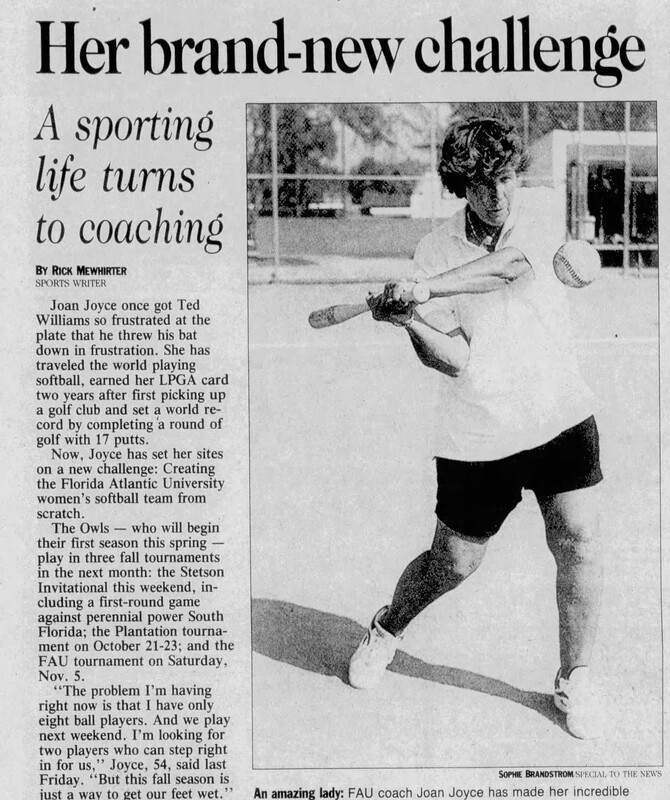
Joyce “did not participate in protests, hold message posters, or sign petitions” yet her decades of coaching, her mother-figure role, and her insistence on excellence created space for women athletics and reshaped FAU softball athletics program. Her form of quiet activism shows how individuals transform the university by committing themselves to their craft, their students, and their community. The stories in this section illuminate the personal, often unrecognized labor that - like Joyce’s - made FAU what it is today. In this way, the individuals featured in this section embody the histories of FAU that often remain quiet, personal, and deeply human.
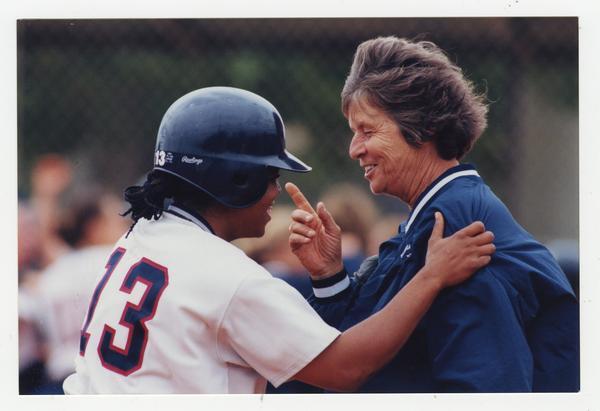
Mentorship & Coaching Relationships Under Joan Joyce
This photo display a focus on Joan Joyce's role as a mentor and coach to her players. Former softball player and former assistant coach Chan Walker asserts, “she wasn’t a mother figure; she became my mother.” A player in this photo would share the same sentiments as others who recall how Joyce greeted and comforted them like family during struggles. She also pushed them with her knowledge; “If you ever gave her an answer, she rebutted it very quickly with her knowledge.” These materials document the deep emotional bonds, teaching strategies, and Owl’s players' influence throughout her 28 years at FAU.
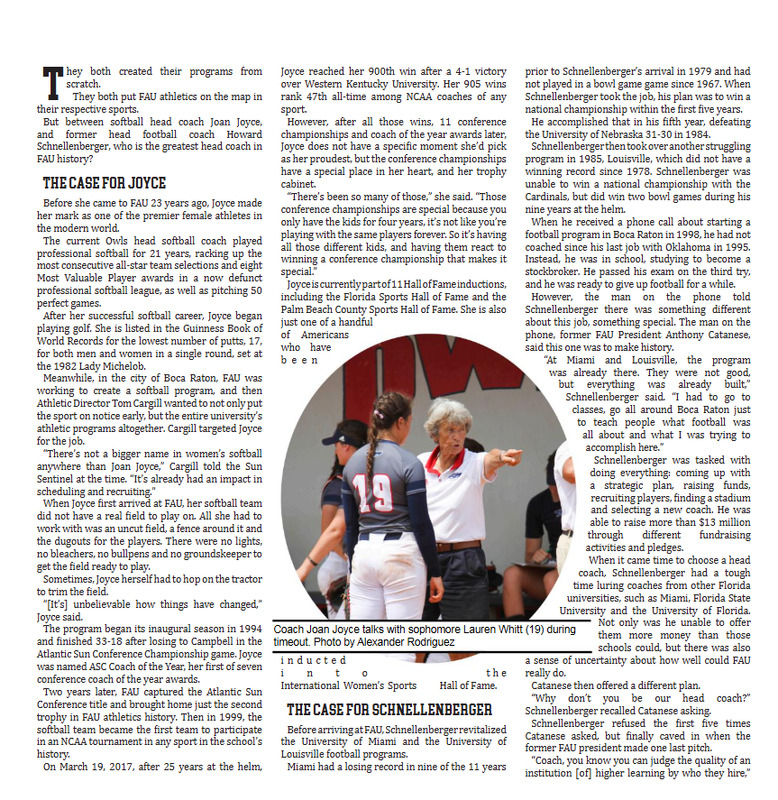
Joan Joyce’s story is important because it shows how one woman in a male-dominant athletic world became a pioneer, architect, and creator of a softball program “from the ground up,” building success through dedication, teaching, and care. Her impact was not expressed through protests or signs, but through mentoring, volunteer labor and shaping lives. Her activism and promoting education of the sport – i.e., softball to players - also implemented, not only learning mechanics, but the education of studying and learning about softball. Due to her training and knowledge of softball, she was able to strike out former Red Sox player Ted Williams.
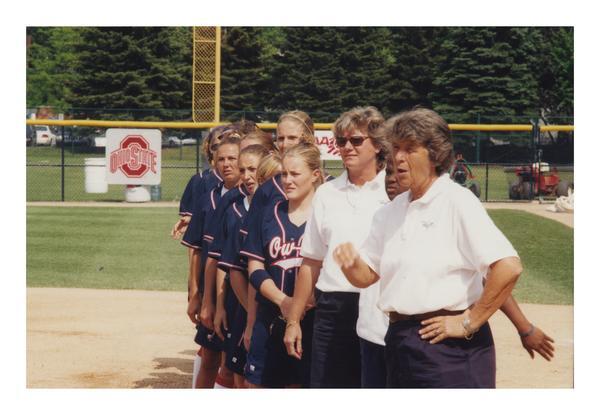
Teaching the Game: Fundamentals, Strategy, and Excellence
This highlights Joan Joyce's philosophy of teaching and mastering the game. Joyce emphasized fundamentals: 'They know how to throw, they know how to catch, they know how to swing the bat,' but insists players must also "learn the nuance of the sport." Her instructions shaped award-winning athletes such as Kylee Hanson, who said, "You learn a lot, and you trust her 100 percent." Materials include accounts of her legendary pitching demonstrations, when she explained to Ted Williams exactly how she threw her curveball, proving 'this girl does know that.'
Legacy & Impact: The Continuing Quiet Activism of Joan Joyce
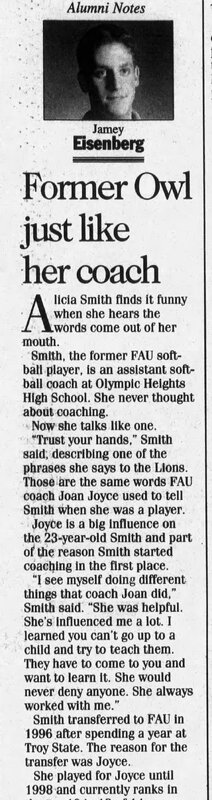
This preserves the legacy of Joan Joyce’s impact on FAU athletics and beyond. As a multi-sport legend, softball, golf, tennis, volleyball, basketball, and ping pong. Joyce's accomplishments included over 1,000 career wins, eight consecutive Atlantic Sun Conference Championships, and leading teams to NCAA tournament appearances. Ex-FAU Owl softball player Alicia Smith honors and imparts her training, and shares the lessons of her coach, Joan Joyce. Jaylen Ford, a high school softball player, notes of her coach, Smith training from Joyce, "She had an impact on the team, just as Joyce had an impact on her.
Activism Through Excellence: How Joan Joyce Shaped FAU Softball and Women's Sports
Her impact was not expressed through protests or signs, but through mentoring, volunteer labor and shaping lives. A remarkable achievement is her success in founding, serving, and making a long-term commitment to developing programs, as well as being a pioneer head coach of the softball and women's golf teams at Florida Atlantic University for twenty-eight years. In 1994, former FAU president Anthony Cantanese hired Joyce after discovering her legendary athleticism, thereby transforming the women's activism in athletics for a long time. Joyce's quiet activism enabled young women FAU softball players to remain “in the game,” leading by example in the women's athletics and sports communities over the years and celebrating a 1000th career win, as FAU senior softball player Myah Murray notes, “plays a big role in the girls that were here before us…to be able get her to that goal…to do it at our home field would be more meaningful to Joan and to the whole program.”[1].
Joan Joyce encouraged the FAU Owls players to participate and win for themselves, win for women in sports, and win for one multi-sport player coach. She promoted and demonstrated teamwork, not only leadership, but activism, such as raising competitiveness for softball players at FAU. Under Joyce's direction, the Owls team will become one of the nation's top programs noted by the Florida Sport Hall of Fame. Softball players deserve the same "spirit of competitiveness" and investment historically reserved for men's sports teams.[2] Joyce created FAU softball from scratch, designing the program, and created a Division I women program in a male-oriented space at FAU. She recruited athletics and petitions administrators, in a male-oriented athletics space at FAU.[3]
The biographer Tony Renzoni, Connecticut Softball Legend Joan Joyce emphasized her ability to play the Florida Atlantic University Owl softball players the mechanics of the game. She was a team-player of her early years playing softball with the Raybestos beginning in 1953 at twelve. Joyce was inducted into the National Softball Hall of Fame in 1983 and International Federation Hall of Fame in 1999. She encouraged others to be the best they could be on the field. Maintaining high standards of athleticism with her players at FAU as Joan states, “I think the best asset I have is being able to analyze the sport and teach it… a good head for playing the games, understanding what needs to be done and providing advice to players I have coached over the years.”[4]
When she arrived in 1994 she was already a legend - a multi-sport champion, national record-holder, and symbol of perseverance and Joyce observed, “How I am going to recruit anyone to this desolate place?…six years later…it’s now paradise.”[5] She planted the seeds of success immediately, building a 33-18 record in one year.[6] By 1995, she became FAU's Senior Woman Administrator, shaping policies that increased women's sports visibility. These early years were not only athletic achievements, but administrative and institutional activism, proving women's programs deserve investment and leadership, as well.
Joyce activism is also exhibited through volunteerism - exhibited in managing the concession stand, recruiting players, in-house maintenance, training players, and preparing the field, she explains. “We run it… This is the way the team makes money…All volunteer help… [as a result of] us.”[7] Her sister-in-law Ginny Joyce commented, “She has people come and work with her, but you never work under her.”[8]Cleaning dugouts, walls and equipment in extreme temperatures reflected her peaceful activism through daily labor. Joyce's extensive activism through mothering and mentorship. Former FAU Owl's player and later assistant coach Chan Walker said, "She's more like a mother figure to me than anything" moved in with Joyce, after her mother’s passing.[9] Kylee Hanson recalls that Joyce comforted her even in moments of frustration. "If I tell her, the umpire keeps giving me brand new balls...I hate brand new balls, she will say, 'I used to throw [new balls] over the backstop.[10] Jalynn Ford described Joyce "she expected the most all the time."[11] It encouraged Owl players to excel with skill, patience, and unwavering support.
Joyce stated that her dedication to teaching fundamentals was a form of education activism, as she insisted, "We all need to do a better job and teaching the younger generation…basically the fundamentals of playing the game…They don’t understand the game."[12] Her lifelong challenge to gender expectations was exemplified when she struck out former professional Red Sox baseball player Ted Williams, who told her, “how’d you throw that curveball?” So I took the ball from my glove and demonstrated how I gripped and spun it.” Williams told her, “You know girls aren't supposed to know that.” She replied, “Well, this girl does know that.”[13]Williams re-enforced his attitudes towards women athletics in a male-centric society.
Joan Joyce’s quiet activism as an individual a woman in a male-dominant space. Showcasing her actions as one of the first architects and creators of a softball program from the ground up, she achieves success through dedication, mentoring and a lasting legacy. Significantly altered FAU athletes and extended opportunities for young women athletes. The chronicle outlines how quiet activism, membership, mentorship, training, and teaching employed. Joyce formed the Florida Atlantic University Owl Softball team as part of a new program. She assisted in the recruitment of women athletes, petitioned administrators for aid and policy changes, and helped build a Division I women's program within centric of a male-dominated sports program at FAU. These memories of history are important because of excellent sportsmanship, quiet activism and volunteerism that led to the permanent renovation of a university campus’ sports history. This narrative stories helps public understand how individuals can fashion a community and increase opportunities for women's athletics in softball. Most importantly, Florida Atlantic University’s identity is shaped through campus histories of teachings, bonds, and humanity, which are part of the essential life skills represented in campus history as seen in public protests or momentous events.
[1] Gianna Alberti, “FAU Softball Head Coach Joan Joyce Aims to Pass 1000 Career Wins Entering Her 28th Season,” University Press (FAU), February 2, 2022, University Press: FAU Student Magazine.
[2] Boca Raton News (Boca Raton, FL), “Owl’s FAU Winning Streak,” March 5, 2000, 99, accessed November 20, 2025, Boca Raton News.
[3] Ibid.
[4] Tony Renzoni, Connecticut Softball Legend Joan Joyce (Charleston, SC: The History Press, 2019), 166.
[5] Boca Raton News (Boca Raton, FL), “Owl’s FAU Winning Streak,” March 5, 2000, 89, accessed November 20, 2025, Boca Raton News.
[6] Florida Sports Hall of Fame. “Joan Joyce.” Florida Sports Hall of Fame. Accessed November 10, 2025. Florida Sports Hall of Fame.
[7] Zack Kelberman, “Throwing a Curveball,” University Press (FAU Student Magazine), February 26, 2013, vol. 14, no. 22, 6.
[8] Ibid.
[9] Cameron Priester, “When Loyalty Goes Unrewarded,” University Press (FAU Student Magazine), March 15, 2023, vol. 27, no. 4, 8.
[10] Brendan Feeney, “Learning From The Best,” University Press (FAU Student Magazine), vol. 17, no. 14, March 30, 2016, 12, University Press FAU Student Magazine..
[11] Bryce Totz, “FAU Softball: Honoring Former Head Coach Joan Joyce,” University Press (FAU Student Magazine), April 3, 2022, University Press: FAU Student Magazine
[12] Brianna Smith, “First Base With FAU Softball Head Coach Joan Joyce,” The Boca Raton Tribune, (April 30, 2021, 21.) Boca Raton Tribune Newspaper.
[13] Tony Renzoni, Connecticut Softball Legend Joan Joyce (Charleston, SC: The History Press, 2019), 45.